If your dog does the high step, you know exactly what I mean. That stiff-legged march where each paw comes up like it is stepping over something invisible, and the dog looks at you as if you have lost your mind. My Italian Greyhound Pip did it for the first three walks in his QUMY boots. He is seven years old, about 13 pounds, with a thin coat and almost no body fat, so he needs boots on cold mornings. But needing them and wearing them are two different things, and I learned that the hard way on a freezing Flagstaff sidewalk.
We live in Flagstaff, Arizona, where winter mornings sit well below freezing and the sidewalks get salted. Once the salt appeared, bare paws were not an option. I ordered the QUMY boots in mid-December, after the first salted walk left Pip lifting each foot and asking to be carried. The boots themselves were easy to like. They have hook-and-loop straps, a rugged sole, and reflective strips for dark mornings. The challenge was convincing a small dog with strong opinions that four boots were not a punishment. He had opinions about everything, and he was not shy about sharing them.
Boots That Stay On, Without the High-Step Drama
These are the same steps I used to get Pip from high-stepping to trotting in about three walks. If your dog has never worn boots, start here before the next cold morning. The method is simple: slow, familiar, and full of treats.
Amazon Check Today's Price on Amazon →Step 1: Let the Boots Sit Out Where the Dog Can Investigate Them
The first mistake people make is trying to put boots on a dog who has never seen them. You are holding something strange, you are reaching for a paw, and the dog has every reason to pull away. I have seen owners chase a puppy around the kitchen with a boot in each hand, and I do not blame the puppy for running. Instead, I put the QUMY boots on the floor near Pip's bed a full day before we tried them. He sniffed them, nudged them with his nose, and eventually lay down next to them. By the time we attempted the first fitting, the boots were just part of the living room.
Do this when there is no pressure. Not right before a walk, not when the dog is already anxious about the cold, and not when you are in a hurry to get out the door. Let the boots sit out where the dog can investigate them on their own schedule. If your dog is curious, you can roll one boot gently toward them. If your dog is suspicious, leave them alone and try again later. The goal is a dog who thinks the boots are boring, not scary. Boring is your friend here.
I also gave Pip a small treat whenever he sniffed or touched a boot. That simple association did more than any amount of chasing him around the kitchen. Dogs learn through their noses and their stomachs. A boot that smells like a treat is a boot worth investigating. By the time we attempted the first fitting, he had already decided the boots were his own idea, and that made everything that came next much easier.
Step 2: If Four Boots Is Too Much, Start With One
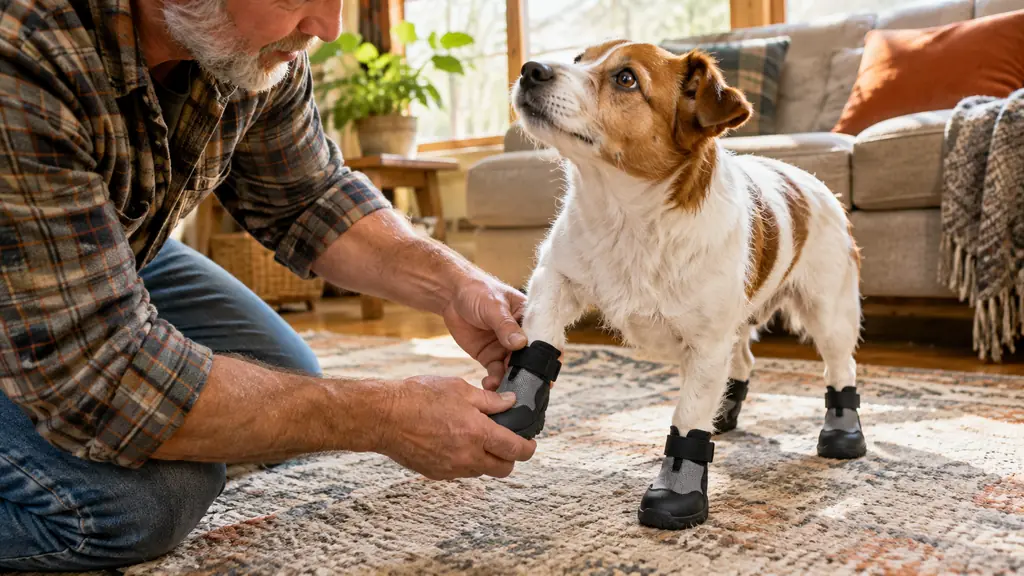
The fastest way to create a high step is to overwhelm a dog with four boots at once. They feel the change on every leg, the ground feels different under each foot, and they do not know how to walk. I understand the temptation to get it over with, but it usually backfires. I put all four on Pip from the first outing, but if your dog panics, start with one front boot instead. Just one. Put it on, let the dog walk around the house for a few minutes, and give them a treat when they take a normal step. One boot is manageable. Four boots are a costume.
Pip's first walk in all four boots was ridiculous in the best way. He lifted each foot high, put it down carefully, and looked at me for reassurance. He took a few steps, stopped, looked at the boot, and took a few more. I stayed calm, kept my voice light, and did not try to fix his gait. Dogs feel our tension. If you laugh at them or grab at their feet, they will read the whole thing as a problem. If you act like wearing boots is the most normal thing in the world, they will start to believe you.
A dog who struggles will often walk normally with one boot after a couple of short sessions. That is the signal to add a second front boot, then the back boots one at a time. Going from zero to four in a single morning is the shortcut to a dog who refuses to move. Going one paw at a time gives the dog time to adjust. It also gives you time to learn how the boots fit on each foot, because front feet and back feet are not the same shape.
Step 3: Make the First Walks Short and on Familiar Ground
The high step is often a texture problem. New boots feel strange on the soles of the feet, so the dog overcorrects and lifts each paw too high. It is the same way you walk when you put on a new pair of shoes that are heavier than you expected. The fix is not more walking. The fix is a short, familiar walk where the dog can build confidence without getting tired or cold. A tired, cold dog will not learn anything.
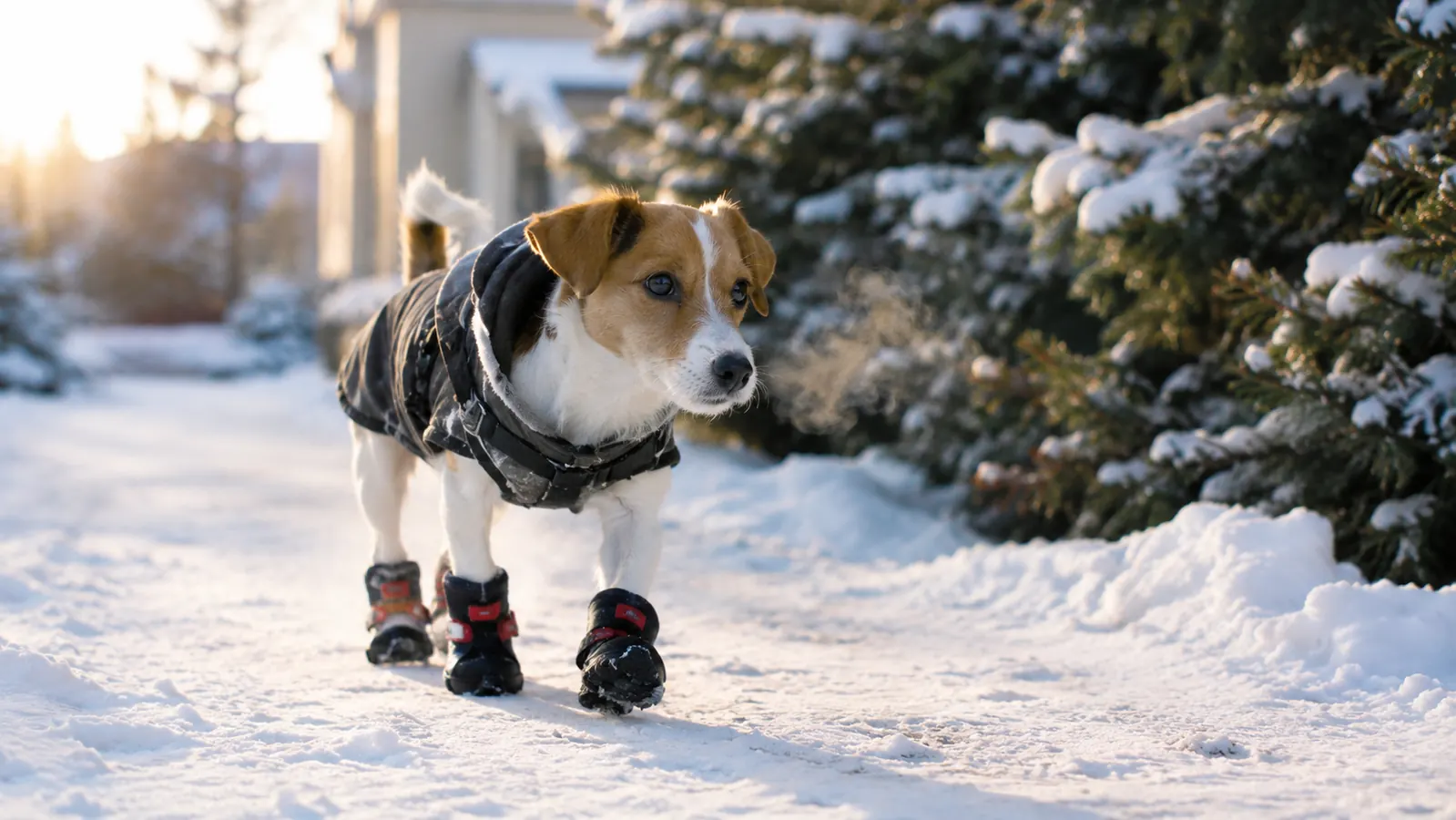
Our first full-boot walk was no more than to the end of the driveway and back. Pip did the high step for the first few minutes, then settled into a normal trot once he realized the boots stayed on. We did that same short loop for two mornings before trying the full neighborhood trail. I wanted him to associate the boots with a successful outing, not with a long, uncomfortable march. Short and happy beats long and miserable every time.
Keep the first walks on surfaces you both know. A quiet sidewalk, a familiar patch of grass, even the hallway of an apartment building. New boots plus a new place plus cold air is too much for most dogs. Change one thing at a time. Once the dog is walking normally on the familiar surface, then you can add the new route. That is how we worked up to our usual one-mile loop, about 25 minutes, without a single high step.
Step 4: Check the Fit and Tighten the Straps Until They Are Snug
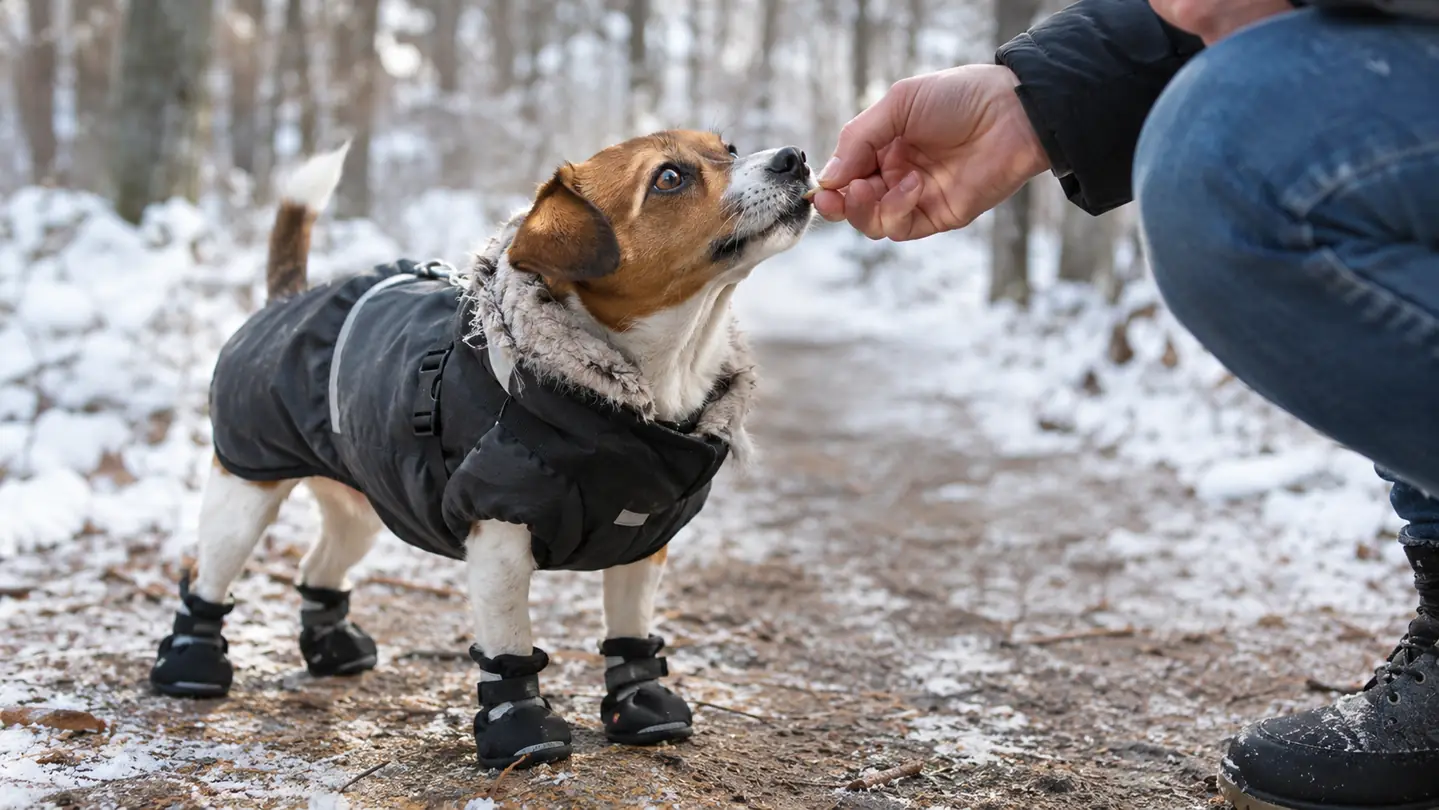
A boot that flops around will make any dog high-step, because the boot is doing the walking for them. The QUMY boots have hook-and-loop straps that you can adjust, and I learned to use them. I made the straps snug enough that the boots did not spin on Pip's foot, but not so tight that they pinched. That Goldilocks fit is the difference between a dog who trots and a dog who walks like a toy soldier. If the boot twists, the dog feels it with every step and will try to shake it off.
Check between the toes and around the ankle before every walk. Snow can pack into a loose boot, and a boot that is too tight can rub. If the dog stops and chews at a foot, take that boot off and look. Pip only managed to pull a boot off once, in deep snow, and I found it a few steps away. After that I got better at the straps. The reflective strips were a nice bonus for early mornings, but the fit is what kept the boots on.
A good test is to hold the boot gently and see if it twists. If it twists easily, tighten it. If you cannot get two fingers between the strap and the leg, loosen it. You want the boot to feel like a snug sock, not a vise. I also learned to check the boots halfway through the walk, especially in snow. Snow can work its way under a strap, and a boot that felt fine at the front door can feel different ten minutes later.
Step 5: Reward Normal Steps and Ignore the Drama
Dogs repeat what gets rewarded. If you give attention, treats, and soothing talk every time your dog high-steps, you are accidentally training the high step. I know because I almost did it. Pip would do that silly march, I would laugh and say his name, and he would do it again. The attention was the reward. Instead, I praised him for normal steps and stayed neutral during the silly ones. He figured out quickly that normal walking was the thing that made me happy.
I carried small treats in my pocket on those early walks. Every time Pip took a few normal steps in the boots, he got a quiet good boy and a piece of something tasty. The moment he started the high step again, I stopped the praise and just waited. No scolding, no fuss. Just a calm pause until he walked normally again. It took patience, but it worked. Within about three walks, the high step was mostly gone.
Within a few walks, Pip was trotting through snow like he had worn boots his whole life. His paws stayed dry, he stopped lifting his feet to ask for help, and the morning walk got much quieter. We did our usual one-mile loop in about 25 minutes without a single pause. The boots stayed on, the high step stayed gone, and the only thing I had to fish out of the snow was that one boot, exactly once, which felt like a win.
What Else Helps
A little paw wax goes a long way on bare-paw days. I keep a tin of wax in my coat pocket for mornings when the ground is dry but cold. Boots are for snow and salt. Wax is for the in-between days. It is not a replacement for boots, but it protects the pads on a quick trip outside. On mornings when the sidewalk is just cold, not wet or salted, wax is faster than four boots and the dog is happier for it.
I also learned to put the boots on before Pip was fully awake. A sleepy dog is a cooperative dog. We would do the fitting on the front porch, then head out before he had time to object. That simple timing trick saved us a lot of high-stepping. If you have a dog who gets excited at the sight of a leash, do the boots first, then the leash. Otherwise the dog is already bouncing and you are trying to fit a moving target.
Within about three walks, the high step was mostly gone, and Pip was trotting through snow with dry paws.
Give It a Few Days, Not a Few Minutes
If your dog does the high step, try these steps in order and give it a few days. Patience and a snug fit beat forcing four boots on in one morning. Check today's price on Amazon and have a set ready before the next cold snap. Your dog will forgive you for the boots, especially once the paws stay warm and dry.
Amazon Check Today's Price on Amazon →